How Long Is a Plumbing Apprenticeship? A Complete Guide
Deciding to become a plumber almost always starts with the same question: how long is a plumbing apprenticeship, really? The honest answer is “it depends”, but it depends on a fairly small set of factors, and once you understand them you can map out a realistic timeline for yourself. This guide walks through the standard length, what actually happens during those years, and what comes next once you’re licensed.
What Is a Plumbing Apprenticeship?
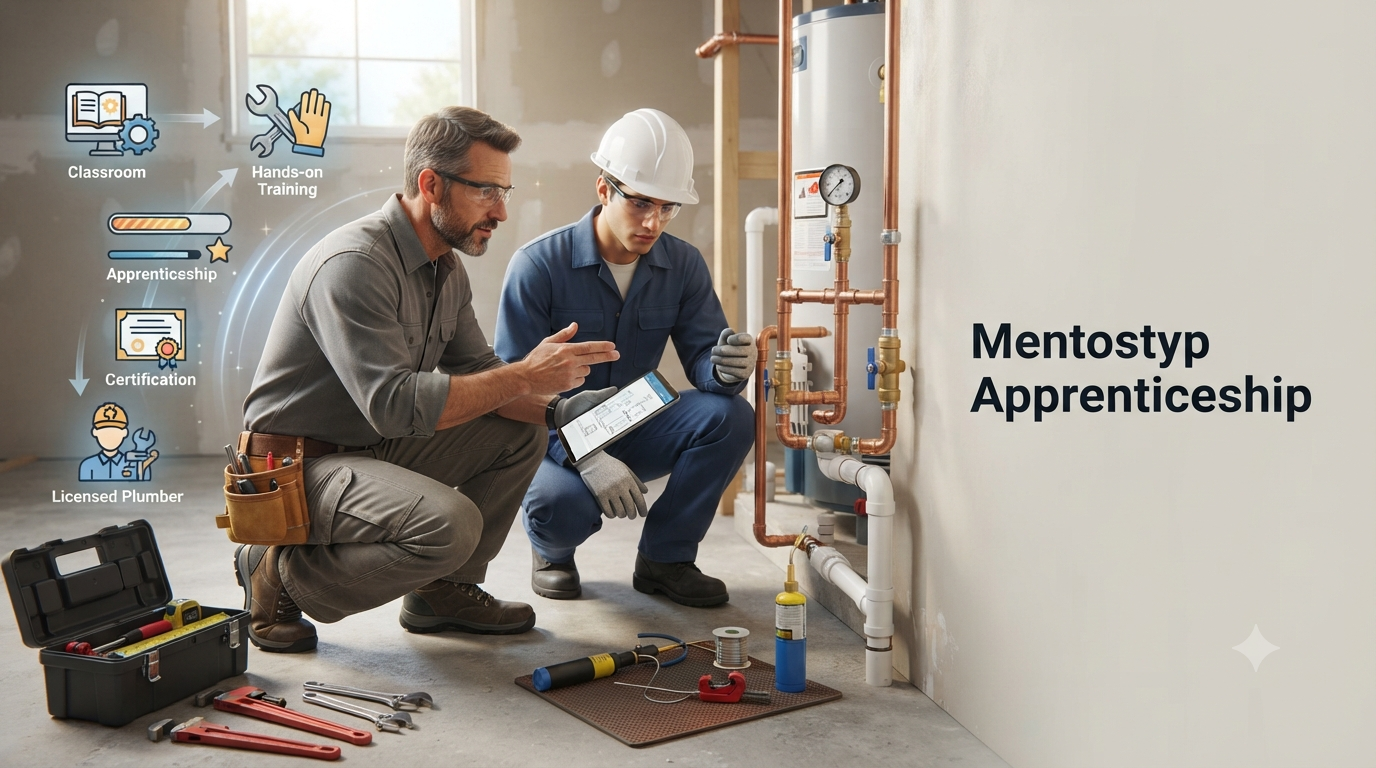
A plumbing apprenticeship is a structured, paid training program that pairs on-the-job work with classroom instruction. You’re not just shadowing someone, you’re logging real hours on real jobs (installing pipe, reading blueprints, running drain lines, troubleshooting systems) while a licensed journeyman or master plumber signs off on your progress. In parallel, you attend technical classes covering code, safety, math, and theory that the field alone won’t teach you.
It’s a legitimate question whether the trade is a good fit before you commit years to it, if you’re still weighing that, it’s worth reading up on is plumbing hard to learn before you enroll, since the physical and technical demands vary a lot by specialty (residential service work looks very different from commercial new-construction).
Union vs. Non-Union Apprenticeships
Not all apprenticeships are structured the same way. The two broad paths are:
| Union Apprenticeship | Non-Union Apprenticeship | |
| Sponsor | Trade union (e.g., UA locals) | Contractor, trade school, or ABC/IEC chapters |
| Structure | Highly standardized, often 5 years | Varies by employer, often 4–5 years |
| Pay progression | Fixed percentage scale, often higher | Employer-set, more variable |
| Benefits | Health, pension, training fund included | Depends on employer |
| Flexibility | Less, you go where the union places you | More, direct relationship with your employer |
| Job placement | Union hall assigns work | You find or negotiate your own placement |
Union routes tend to offer more predictable benefits and pay steps; non-union routes often offer more flexibility in choosing an employer or specialty. Neither is “better” across the board, it depends on what you value and what’s available in your area.
How Long Does a Plumbing Apprenticeship Actually Take?
The standard length is four to five years. Most U.S. Department of Labor–registered plumbing apprenticeships require:
- ~8,000 hours of on-the-job training (roughly 2,000 hours/year, or a full-time work year)
- ~576–720 hours of related technical instruction (commonly structured as 144 hours/year of classroom time)
A rough year-by-year breakdown looks like this:
- Year 1: Safety, basic tools, pipe fitting fundamentals, code basics
- Year 2: Rough-in plumbing, drain-waste-vent systems, blueprint reading
- Year 3: Water supply systems, fixture installation, more independent work
- Year 4: Specialized systems (gas lines, backflow prevention, commercial work), exam prep
- Year 5 (if required): Advanced/commercial specialization, journeyman exam eligibility
Factors That Change Your Timeline
- State requirements. Every state sets its own minimum hours and exam requirements, so a 4-year program in one state might be a 5-year program in another.
- Full-time vs. part-time. Part-time apprentices log hours more slowly, which stretches the calendar timeline even though total required hours stay the same.
- Prior experience or coursework. Military training, vocational school credit, or documented prior plumbing hours can sometimes shorten the required time.
- Program pacing. Some programs run rolling cohorts; others only start once a year, which affects how quickly you can begin logging hours.
Steps to Become a Plumber
- Meet the basic requirements. Most programs require a high school diploma or GED, and some prefer coursework in math or physical science.
- Find and apply to a program. Search union locals, trade schools, or contractors directly. Have a resume ready and expect an interview, competitive programs get more applicants than slots.
- Log your on-the-job hours. This is where most of the apprenticeship happens, working under a licensed plumber on real jobs.
- Complete your classroom hours. Usually evenings or scheduled blocks alongside your job hours.
- Apply for and pass your licensing exam. Requirements are state- and often city-specific, for example, if you’re training locally, it’s worth checking the exact steps to get plumbing license edmond rather than assuming your state’s general rules apply, since municipalities can layer on additional requirements.
It also helps early on to build good habits around how you track jobs, tools, and hours. Apprentices who figure out how to organize plumbing work and paperwork from day one tend to move through their hours with far less friction than those who are constantly hunting for a signed timesheet or a missing part.
Is Plumbing a Blue-Collar Job?
Yes, plumbing is classified as a skilled trade and falls squarely under the blue-collar umbrella, though that label undersells what the work actually involves today. Modern plumbers read technical code books, use diagnostic cameras and electronic leak-detection tools, and increasingly work on smart-home water systems. If you’re curious how the classification affects pay, respect, and career mobility, it’s worth reading more on is plumbing blue collar work and how the trade has evolved.
Benefits of Completing a Plumbing Apprenticeship
- Skill development. You leave with hands-on competency, not just theory, the kind of experience that’s hard to fake in an interview.
- Career progression. Completing your apprenticeship is the gateway to journeyman status, and eventually master plumber.
- Stable, in-demand work. Skilled plumbers are consistently in demand, and licensed trades are relatively insulated from the cycles that hit some white-collar fields harder.
- A path to ownership. Many plumbers eventually go independent. If that’s the long-term goal, it’s worth reading about how to start a plumbing business well before you’re licensed, since things like insurance, bonding, and business structure take time to set up properly.
- Room to grow your client base. Once you’re licensed, whether employed or running your own outfit, learning how to get more plumbing work consistently is what actually determines your income ceiling, more than the license itself.
Frequently Asked Questions
What qualifications do you need for a plumbing apprenticeship? A high school diploma or GED, and in many programs, some foundational math or science coursework. Some programs also require you to pass a basic aptitude test (mechanical reasoning, basic algebra) before acceptance.
How much do plumbing apprentices get paid? Pay typically starts at 40–50% of a licensed journeyman’s wage and increases in steps as you accumulate hours, often adjusted every six months to a year. Union programs usually publish a fixed pay scale; non-union pay varies by employer.
Can you complete a plumbing apprenticeship online? The classroom/technical portion can often be completed online or hybrid. The on-the-job hours cannot, hands-on, supervised field work is a non-negotiable part of every registered apprenticeship.
What happens after completing a plumbing apprenticeship? You become eligible to sit for your journeyman licensing exam. After passing, you can work as a licensed journeyman, and with additional experience (and sometimes an additional exam), pursue master plumber status or business ownership.
How does the apprenticeship process differ across states? States vary in required hours, exam content, and renewal/continuing-education rules. Some cities layer on their own licensing steps on top of state requirements, so it’s worth checking local rules specifically rather than assuming they match your state’s baseline.
Final Thoughts
A plumbing apprenticeship is a real commitment, typically four to five years, but it’s also one of the more direct paths to a stable, well-paid, in-demand trade. Understanding the timeline, the hour requirements, and what comes after licensing puts you in a much better position to plan around it, whether your goal is steady journeyman work or eventually running your own shop.