
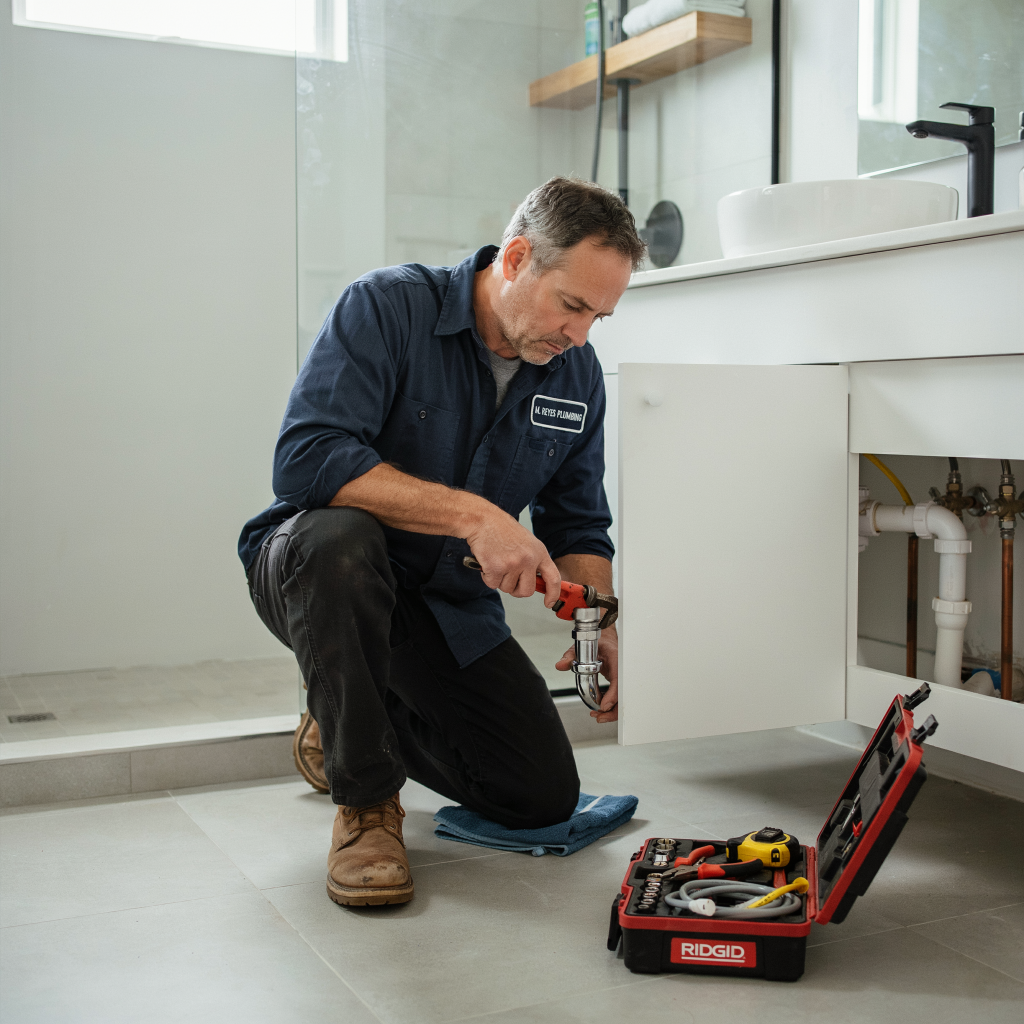
Plumbing emergencies do not keep business hours. A supply line lets go at 2am, a water heater splits on a Sunday, a main line backs up the night before you have family staying. We answer the phone around the clock across Edmond.
Before we get there
Two things make a genuine difference to what this ends up costing you:
- Shut the water off. In most Edmond homes the main shut-off is either in a box near the street or on the wall where the supply enters the garage. Newer builds off Covell and in Deer Creek usually have it in the garage. If you cannot find it, we will walk you through it on the phone.
- Kill the power to that area if water is anywhere near outlets, the panel, or a ceiling light below the leak.
Every minute of running water is more drywall and more flooring. Getting the valve closed matters more than getting us there fast.
What counts as an emergency
Anything actively causing damage or making the house unusable: a burst or leaking pipe, sewage backing up into a tub or floor drain, a water heater leaking from the tank body, no water at all, a gas smell near a water heater, or a slab leak you can hear running under the floor.
A dripping tap, a running toilet or a slow drain is not an emergency. Those we will happily book for the next working day at normal rates, and we will tell you so on the phone rather than charging you an emergency call-out you did not need.
What it costs
After-hours call-outs carry a fee that is waived if you go ahead with the repair. The repair itself is quoted as a fixed price before we start, exactly as it would be during the day. There is no “emergency multiplier” applied to the parts and labour.
Winter in Oklahoma
Our busiest emergency nights of the year are hard freezes. Oklahoma housing stock is not built for sustained sub-zero cold, and the February 2021 storm proved it across the whole metro. Uninsulated pipes in exterior walls, garages and crawl spaces are where they fail. If a hard freeze is forecast, open the cabinet doors under sinks on exterior walls and leave a pencil-thin trickle running on the furthest tap from the meter.